How to Follow Up on Commercial Cleaning Enquiries

I aim to reply to commercial cleaning enquiries within minutes during working hours - and within 24 hours at the latest. My first reply checks the basic requirements and offers two walkthrough times, rather than rushing into a price.
Here’s the process I recommend:
- Assign an owner: record each enquiry, preferred contact channel and next action in your CRM - even for exclusive leads.
- Check before quoting: confirm the cleaning tasks, schedule, access, decision-maker and contract dates. Arrange a walkthrough where needed.
- Put it in writing: confirm the visit, recap the agreed scope and aim to send the quote within 24 hours once the details are clear.
- Follow up with a purpose: answer questions and agree a decision date. If there’s no reply, stop after 3–5 attempts over roughly two weeks.
The aim is simple: <u>make the next step clear</u>, keep a written record and respect a no or a request to get back in touch later.
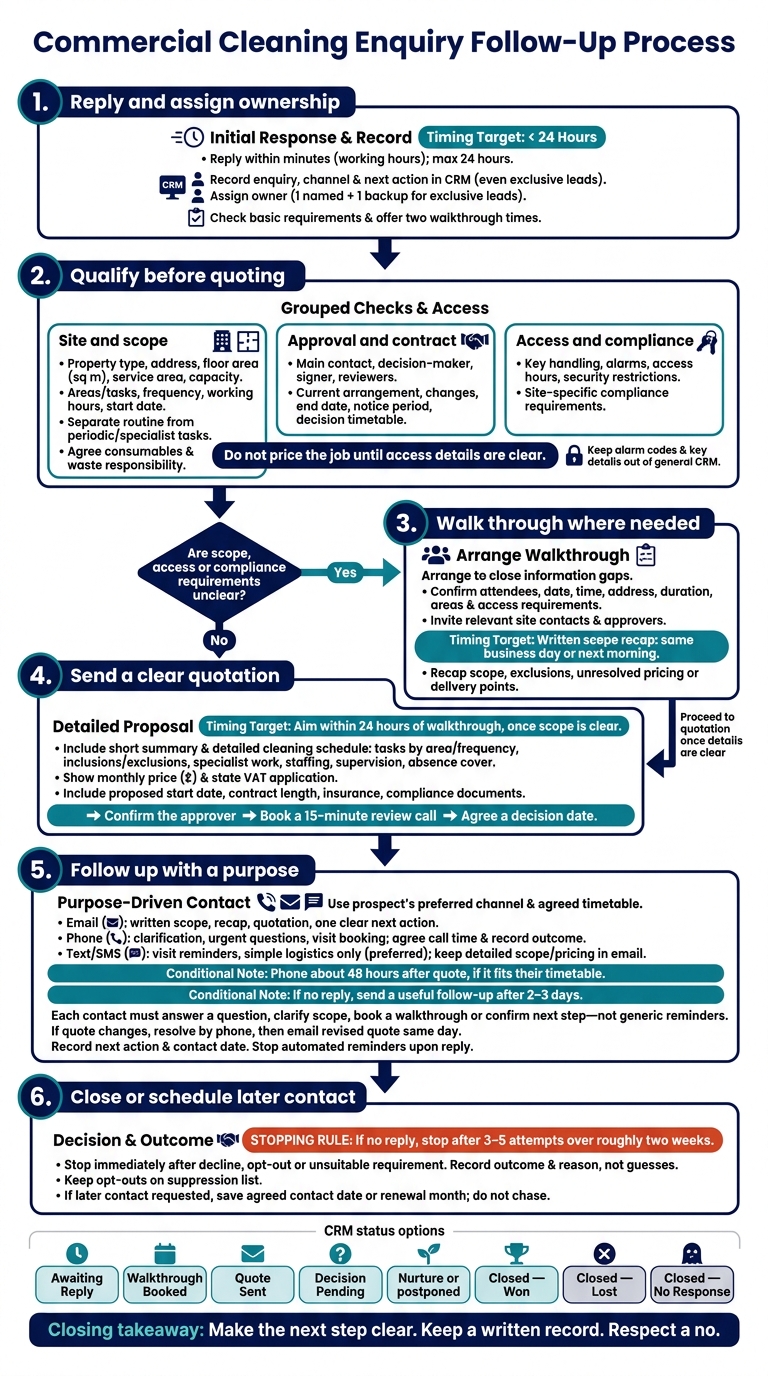
Commercial Cleaning Enquiry Follow-Up Process
Contents
Don't Let Cleaning Leads Slip Away! Effective Follow Up Strategies for Cleaners
sbb-itb-abcad65
Check the cleaning requirements before quoting
Check the job requirements before you quote so you can price it accurately. Record only the details that affect scope, access and the start date.
Confirm the property, tasks and cleaning schedule
Record the property type, address, postcode and approximate floor area in square metres. Make sure the site falls within your service area and that you have capacity for the work.
Confirm which areas need cleaning, how often, the preferred working hours and the proposed start date. Keep routine cleaning separate from periodic or specialist tasks. Agree who supplies washroom consumables and who handles waste disposal.
Check access, approval steps and contract dates
Record the main contact, decision-maker and contract signer separately. Ask who reviews quotes, who currently cleans the site and what needs to change. Before agreeing a start date, confirm the current contract’s end date, notice period and the timetable for a decision.
Check key handling, alarms, permitted access hours, security restrictions and site-specific compliance requirements. Do not price the job until access details are clear. Record access requirements, but keep alarm codes and key details out of the general CRM. Once you have this information, move on to the walkthrough and quotation.
Decide whether to arrange a walkthrough
Arrange a walkthrough if scope, access or compliance requirements are unclear. Explain what you need to inspect: floor area, layout, high-traffic areas, specialist tasks and waste routes. Ask the facilities manager or daily site contact to attend.
Use the details already recorded to focus the walkthrough on the remaining gaps you need to close before quoting.
Confirm the walkthrough and prepare the quotation
Confirm the visit and record the agreed scope
Once the walkthrough is booked, confirm who’s attending, how to access the site and which areas you’ll inspect. Send a confirmation straight away. Invite the site contact, facilities manager and contract signer if they need to attend. Replace the bracketed details in this template before sending.
Subject: Cleaning walkthrough confirmation - [site address]
Confirming our visit on [date] at [time] at [full address]. Please allow [duration].
Attending: [names and roles]. We will inspect [agreed areas].
Please confirm parking arrangements and any visitor or building access requirements.
Send a written recap the same business day or the next morning. Record the final agreed scope, exclusions and any pricing or delivery points still to be settled.
Make the quotation easy to review
Turn your walkthrough notes into a quote that approvers can review and share. Start with a short summary and attach the detailed cleaning schedule. Set out tasks by area and frequency, areas included and excluded, specialist work, staffing, supervision and absence cover. Show the monthly price in £ and state how VAT applies.
Include the proposed start date, contract length, insurance details and compliance documents. Aim to send the quote within 24 hours of the walkthrough, once the scope is clear. Confirm who will approve it, book a 15-minute review call and agree a decision date.
After sending the quote, follow up through the prospect’s preferred channel.
Use email and phone to move the enquiry forward
| Channel | Best use | Strengths | Recommended action |
|---|---|---|---|
| Scope records, quotation delivery and follow-up | Gives approvers a written record they can share | Send the recap and quotation with one clear next action. Confirm receipt if needed: emails can be missed or filtered. | |
| Phone | Clarification, urgent questions and booking visits | Lets you resolve questions in conversation | Agree a call time so you don’t interrupt busy managers, and record the outcome. Follow up by phone about 48 hours after sending the quote, if that fits their timetable. |
| Text/SMS | Visit reminders and simple logistics | Helps with time-sensitive updates | Use only if this is the prospect’s preferred channel. Keep detailed scope and pricing in email. |
If the quotation needs changing, resolve the change by phone, then email the revised quote the same day. Respect the prospect’s preferred contact method and agreed timetable.
Plan follow-ups and know when to stop
Set contact dates and write follow-ups that add value
Once a walkthrough or quote is in motion, keep contact purposeful. Record the next action and contact date for every enquiry, then work towards a decision or a clear stopping point. If there’s no reply, send a useful follow-up after 2–3 days. Stop after 3–5 attempts over roughly two weeks. For quotes, record whether the prospect has seen the proposal and any questions they have.
Each follow-up should answer a likely question, help book a walkthrough or confirm the next step. For quotes, record who’s reviewing the proposal and agree a clear decision date.
Skip generic reminders. Send a short scope checklist or ask a question that helps you qualify the job. If the prospect asks you to get back in touch later, save the renewal month or agreed contact date in the CRM.
Outstanding quotation: “Is the scope clear enough for your review, or is there a section you would like me to revise or explain?”
Final message: “I haven’t heard back so I’ll assume the timing isn’t right. If you’d like to pick this up later, just reply here.”
These contact rules also apply to exclusive enquiries, though the process needs a few extra steps.
Set up a process for exclusive commercial enquiries
Assign one named owner and one named backup to each enquiry. Keep site details, decision-makers and the next action in one CRM. Include checks for the site, scope and decision-maker, alongside available walkthrough slots, a quotation deadline and contact limits. Stop automated reminders as soon as someone replies so the owner can take over.
Shared lead platforms typically send the same enquiry to several businesses. CleanLeadSolution gives one cleaning company per service area commercial-only, pre-screened enquiries ready to quote, with no bidding or cold calling by the cleaning company. Check service-area availability first. Exclusive enquiries still need organised follow-up and clear contact limits.
If the prospect stays silent or declines, close the enquiry rather than continuing to chase it.
Stop following up and record the outcome
Use the CRM pipeline stages to track each enquiry: Awaiting Reply, Walkthrough Booked, Quote Sent, Decision Pending, Nurture or postponed, Closed - Won, Closed - Lost and Closed - No Response.
Stop after a decline, opt-out, unsuitable requirement or the capped unanswered sequence. Record the reason rather than guessing. If the prospect wants contact later, save the agreed date or renewal month in the CRM. Keep opt-outs on a suppression list across your tools.
FAQs
What should I say in my first reply?
Reply promptly and keep it brief. Thank them for their enquiry, confirm you understand their cleaning needs, and suggest a clear next step - usually a site walkthrough. Offer a specific time to visit the premises or have a short call.
Make it easy for the prospect to move forward. You don’t need to pitch your full service yet, so leave out brochures and extra detail.
How do I handle objections to my quote?
Before offering a discount in response to a price objection, check the scope and frequency again. If timing is the problem, ask when their current contract ends and diarise a check-in. If they need approval, offer a one-page summary they can forward.
If they’re unsure, suggest a short call to review the proposal and answer their questions. Keep follow-ups brief and don’t invent deadlines. Before following up again, confirm whether they want to proceed, decline or wait.
How should I follow up after a verbal yes?
Once the client says yes, shift from sales to onboarding. Confirm the next steps straight away, including when you’ll send the contract and finish any admin.
Ask how they’d like to receive the agreement, then arrange a short call to walk through it after you’ve sent it and answer any final questions. Update your internal records and track progress until the contract is signed.